| TRAINING STRATEGY 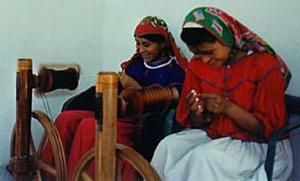
PROBLEMS
THAT CAN OCCUR AND ADVANTAGES OF A TRAINING CENTRE:
From our
experience in the Sierra teaching Huichol women to use
spinning wheels we have devised the following strategy:
1) Huichol women often don't speak very good Spanish,
some speak none at all. Quite apart from the language
problem many are very shy, and completely unable to speak
to strangers.
It is important to have a Huichol woman as an instructor.
2) Huichol women nearly always have a lot of family
around them which is a tremendous distraction if you are
trying to teach somebody something because they all want
to see and shout things and poke fun at the poor women
who may be trying to work a treadle for the first time in
her life, and is struggling to master the co ordination
to make the wheel go round, never mind which way round it
turns.
Huichol women have a great many things to do in the
course of a day, and its difficult to get one person to
sit down quietly for any time. They are always off to
make tortillas, or to wash the clothes, or fetch the
goats, or something.
The best way to teach a Huichol woman how to spin is to
invite her to stay somewhere far away from home .
3) Many Huichol live in remote ranchos with only tracks
over the mountains between them. Travelling is time
consuming and one can never be certain of finding the
person at home.
It is better to teach in a training centre where several
women can come at one time to learn.
4) It is not enough that a person knows how to spin with
a spinning wheel, a person really needs to be at ease and
fluent at spinning to be able to make commercial use of
her spinning wheel. In practice we find that most people
can learn to spin in a week and in two weeks they may
feel that they know it all when in fact they don't, that
actually takes about another two weeks. This makes for a
total of a month long training period.
5) It is important for the owner of a spinning wheel to
know how to look after it, and to learn good rituals of
maintenance.
Good rituals of maintenance are best learned by keeping
company for a lengthy period of time with someone who can
give a good example.
A time period of a month also about the period needed for
the person to become familiar with the solutions to
problems that can occur with a spinning wheel on the
basis that everything that could go wrong, will go wrong
within this time.
5) The objective that as many Huichol women as possible
should benefit from the spinning wheel presents the
problem of how to distribute them to those who will
benefit most. One cannot sell them because very few
Huichol women have enough money to buy a spinning wheel,
especially when it is something new and they don't know
how to make good use of it.
One cannot just give them away to likely candidates (a)
because people are very jealous and (b) because what is
easily gained is easily lost, which is to say that the
gifts would not be appreciated and used.
For a person to decide to leave home for a month is a big
decision, and the spinning wheel is a worthy prize. It is
a well balanced affair, and nobody can be jealous because
it is an option truly open to all.
TRAINING
PROGRAM:
With the above aims in view we set up a training centre
at our base in La Cruz de Huanacaxtle. We built as I
described earlier, a Huichol style house on our roof with
a kitchen and laundry. We took special care to make the
place as cool as possible, with plenty of ventilation and
mosquito netting because La Cruz is warmer than the their
natural home in the Sierra. ( Generally speaking the
Huichol seem to be unperturbed by fleas but mosquitoes
drive them mad. )
As soon as the first spinning wheels were ready I drove
to the Sierra ( a 1,400 kilometre round trip ) to visit
with a Huichol family we have known for many years.
Because there are no telephones in the Sierra, they could
not know I was coming, but since we had talked often of
the plan to come and learn to spin with the spinning
wheel they were not surprised to see me. Nevertheless it
is a bit precipitative to suddenly arrive and want to
leave the next day with the women of the house,
especially if there has been no precedent. Fortunately I
am trusted sufficiently well, and succeeded in bringing
back two Huichol women, Emilia and Alicia. Naturally I
had also to bring back their dependent children . Of
Emilia's 8 children, only one was so small that he had to
come with his mother. Of Alicia's three children two had
to travel with her.
The next day I drove back with the two women and three
children. Once back at base everything started well, but
soon we realised that Emilia was suffering from a severe
rash, and bad eyesight ( she is 40 years old), and that
Alicia had colitis and the children diarrhoea. It took a
visit to the optician, a series of visits to the doctor
and a small pharmacy of medicines and almost three weeks
to cure all these problems. The causes were a mixture of
allergies, amoebas and various types of worms.
Meanwhile the spinning proceeded. Emilia already knew how
to spin with a spindle very well, and she rapidly learnt
to spin with the wheel. Alicia had never spun before, but
she picked it up from Emilia, and although she was
slower, she was already precise and consistent after
spinning about a pound of wool. They both made steady
progress, and they also enjoyed their stay on the coast,
going for walks to the beach, to the village plaza, and
occasionally into Vallarta to go shopping. (We paid them
a little so that they could buy something for their
families when they returned.)
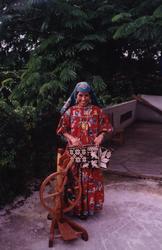
By the time Emilia had spun enough wool to weave a set of
three pouches she was completely fluid with her new
machine. We made up the pieces of wood for a back strap
loom for her to use, which she then warped up and she
started to weave a set of three pouches. She was spinning
and weaving alternating these activities. This was very
good for Alicia who only knew simple weaving up till
then.
Emilia just finished her weaving by the time she was due
to go back. I drove her back up to the Sierra with the
intention of finding two more students, but by now it was
the end of June and well into the rainy season. At this
time of year every able bodied Huichol is busy plowing,
planting, or weeding the crops, first maize, then beans
and squash. I found several women who really wanted to
come, but it was impossible for them to leave their
families at such a critical time. I hunted everywhere
hoping to find someone without obligations, and although
I found two ladies with less obligations, apparently
there was no one without obligations. Everyone kept
telling me 'December'.
I took Emilia to the Huichol Centre that Susana Valadez
has started in Huejuquilla. This is one the first
important towns that you come to as you leave the Sierra,
and there are always many Huichol passing through. Susana
works mostly with beads, but she is interested in working
with wool also, although she herself does not know how to
spin so I introduced her to Emilia. Emilia has been
spinning and weaving all her life and knows important
things such as where to buy wool amongst the Tepehuanes
who live nearby and who have many sheep. Soon Emilia will
teach spinning and weaving at Susana's place and I left
two spinning wheels with Susan for her first students.
At the moment we are looking for our next students who
will probably come from the Huichol Cultural Centre in
Santiago Ixcuintla run by Mariano Valadez. Meanwhile
Alicia is exploring new lines of articles that Huichol
can weave which are easier to sell than pouches. At the
moment she is making a set of cushion covers which are a
fine double weave on the face side, and a simpler weave
on the reverse.
I am making a compact frame loom which Alicia will set up
to weave cloth for a type of woollen jacket which I feel
sure will sell well, also to the Huichol themselves.
SUMMARY OF THE TRAINING PROGRAM:
CONDITIONS
OF TRAINING:
1. Huichol women come to learn at a training centre for a
period of a month.
2. They can bring their youngest children.
3. They are taught by a skilled Huichol woman.
4. They will receive payment half will be given in
advance because they need money for food for their
families, and the rest on completion of the course.
5. All costs will be paid, transport, medicine for most
common treatments, food, soap, spectacles, etc.
6. Those who prove skilled in the use of the spinning
wheel will receive a spinning wheel and two extra bobbins
and a set of carders as a gift on leaving.
BASIC
INSTRUCTION:
1. Spinning fast and efficiently. How to produce
different types of thread such as strong hard wearing
thread for bags etc, and soft open warm types for
blankets. Plying efficiently. Skeining. Yarn Count.
2. Preparation of fibre washing methods, oiling, carding.
Control of quality of fibre.
3. Use and care of the spinning wheel: Oiling, changing
cord, adjusting tension, how to deal with all the
problems that may occur.
EXTRA
INSTRUCTION:
According to the interest of the student we aim at being
able to offer the the following instruction:
4. The production of formerly used traditional items for
use in the Sierra, such as blankets and warm jackets, and
other items that are aimed at selling to foreigners such
as cushion covers, kangaroo pouches etc.
5. Different types of weaving with a back strap loom,
(not all Huichol women know their own traditional types
of weaving).
6. How to set up a frame loom, and weave with foot
powered heddles.
7. Dyeing with natural dyes and use of mordants.
8. Dying with synthetic dyes.
Top of the Page
|