My study of Huichol
weaving began in 1985 and owes much to the ground
breaking research of Susana Eger Valadez on Huichol
women's art (Eger 1978). At the Valadez's Centre
for Huichol Cultural Survival and the Arts in Santiago
Ixcuintla, Nayarit, Susana oriented me, provided generous
help and guidance, and introduced me to women who are
master weavers and artisans. I made important
contacts with the women from two families living in the
San Andrés Cohimiata part of the Sierra, and spent three
years living with these families and conducting weaving
research .
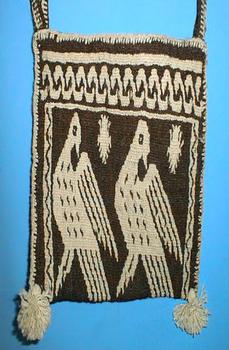
Following an approach similar to that of Gladys Reichard
(1934) among the Navajo, I learned to weave on a back
strap loom under the instruction of a Huichol weaver. I
also participated in the daily and ceremonial activities,
which included attending ceremonies at the San José
temple and accompanying family members on their
pilgrimage to Virikuta in 1987. . . . .
... a little further on is her description of the loom as
a model of Solar Time:
The first level of the loom model expresses time as a
solar event in which day and night are represented by the
path of the sun. As my teachers themselves deeply
immersed in the ideology and technology of weaving
explained, the warp yarns represent the path of the sun,
and the sticks of the loom represent the geographic
landmarks of the sacred places which the sun passes along
its journey. There are many sacred places in Huichol
geography, and although it is not possible to represent
each of these in the loom, the interpretation of the
women in one family, as explained below, indicate
mountains or hills, which form a kind of ladder from the
sky in the east to the mountains in the west.
The first loom stick, kuaterai
, is the top beam and indicates the farthest and highest
eastern sacred place visited by the Huichols. (See
drawing). This spot is a mountain lake known as
Sinamekuta. The goddess of this lake makes the clouds
which bring rain to the Sierra and the Pacific Ocean.
Continue>>>
|